

Introduction
Artificial intelligence is moving beyond simple chatbots and automated responses. AI agents are becoming capable of understanding goals, making decisions, using tools, and completing multi-step tasks.
For businesses, this creates an opportunity to automate repetitive processes while allowing teams to focus on higher-value work.
What Is an AI Agent?
An AI agent is a software system that can understand a goal, determine the steps required to achieve it, and interact with other tools or systems to complete those tasks.
Unlike a traditional automation that follows a fixed sequence, an AI agent can evaluate information and adapt its actions based on the situation.
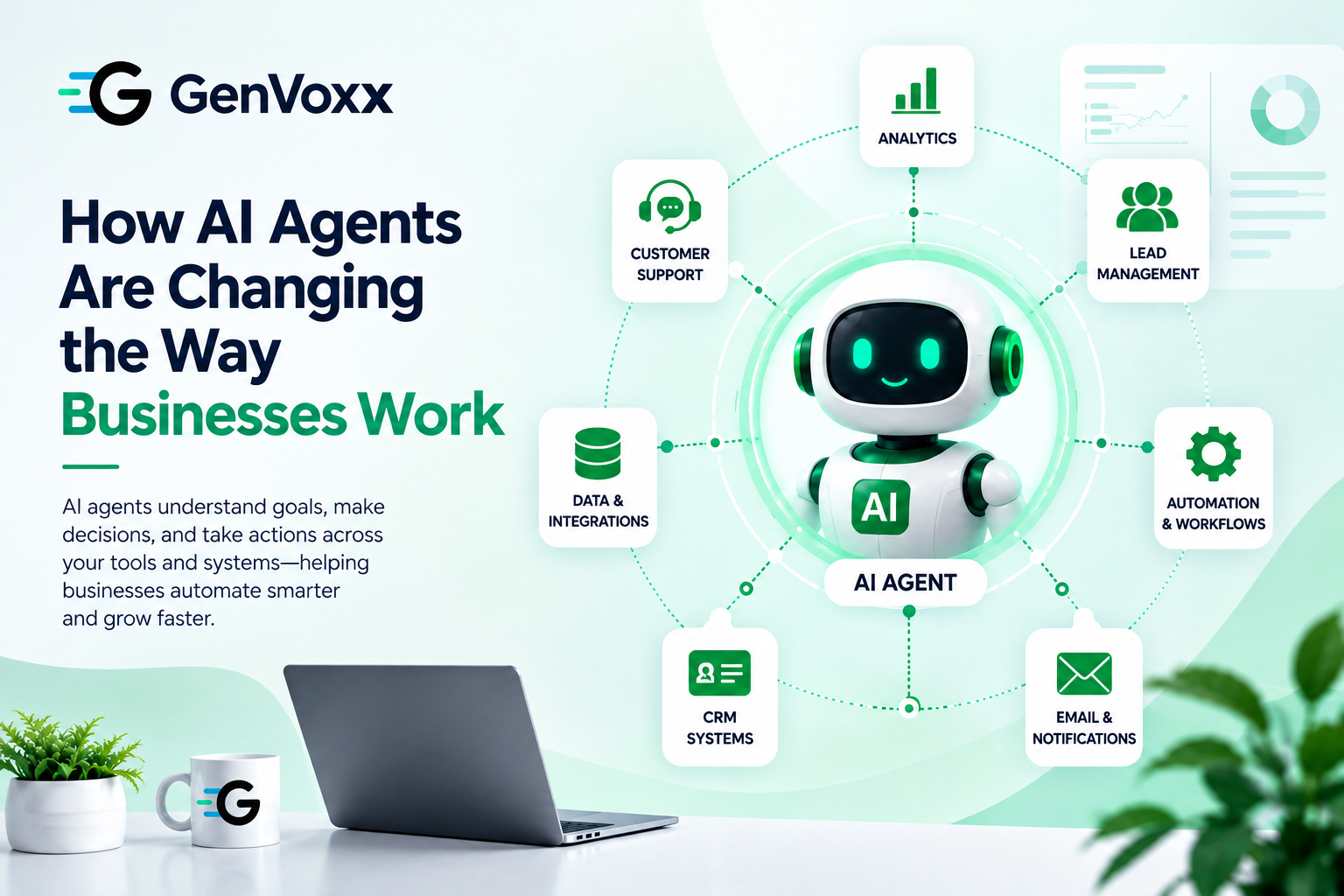
For example, an AI agent could receive a customer inquiry, understand the request, retrieve information from a CRM, prepare a response, and notify a sales representative when human involvement is required.
AI agents are most valuable when they connect intelligence with real business actions.
Where Businesses Can Use AI Agents
1. Customer Support
AI agents can handle common customer questions, retrieve information, and assist customers around the clock.
They can also identify complex requests and transfer them to the appropriate team member.
2. Lead Management
AI agents can review incoming leads, collect relevant information, classify prospects, and help sales teams prioritize opportunities.
3. Internal Operations
Businesses can use AI agents to automate repetitive internal tasks such as generating reports, organizing information, processing documents, and coordinating workflows.
4. Marketing
AI agents can assist with content research, campaign analysis, customer segmentation, and marketing workflows.
5. Business Data
AI agents can connect with business systems and help teams retrieve information without manually searching through multiple platforms.
AI Agents vs Traditional Automation
Traditional automation is excellent for predictable, rule-based processes.
For example:
Form submitted → Send email → Create CRM record
An AI-powered workflow can handle more complex situations:
Form submitted → Understand request → Analyze information → Decide next action → Use appropriate business tools → Notify the right person
This makes AI agents particularly useful when processes involve changing information or require decisions.
What Businesses Should Consider Before Implementing AI Agents
AI agents should not be introduced simply because AI is popular.
Before implementation, businesses should identify:
The specific business problem
The process that needs improvement
Available data
Required integrations
Security requirements
Human approval points
Expected business outcomes
The best AI implementations start with a clear business objective.
The Future of AI-Powered Business Systems
AI agents are becoming an important part of modern digital systems. As businesses connect AI with CRMs, databases, APIs, communication platforms, and internal tools, more complex workflows can be automated.
The goal isn't necessarily to replace people. Instead, businesses can use AI to reduce repetitive work, improve response times, and give employees better tools for decision-making.
Conclusion
AI agents can transform business operations when they are designed around real business needs.
The most successful implementations combine AI capabilities with reliable software, automation, integrations, security, and human oversight.
For businesses considering AI, the first step is not choosing an AI model. It is identifying the process that could benefit most from intelligent automation.